Problem
Hydrogen startup Ayrton Energy invented a new way to transport hydrogen and needed to scale their electrochemical cells faster.
Solution
Pulsenics helped Ayrton compress their technology development timeline from five years to just two.
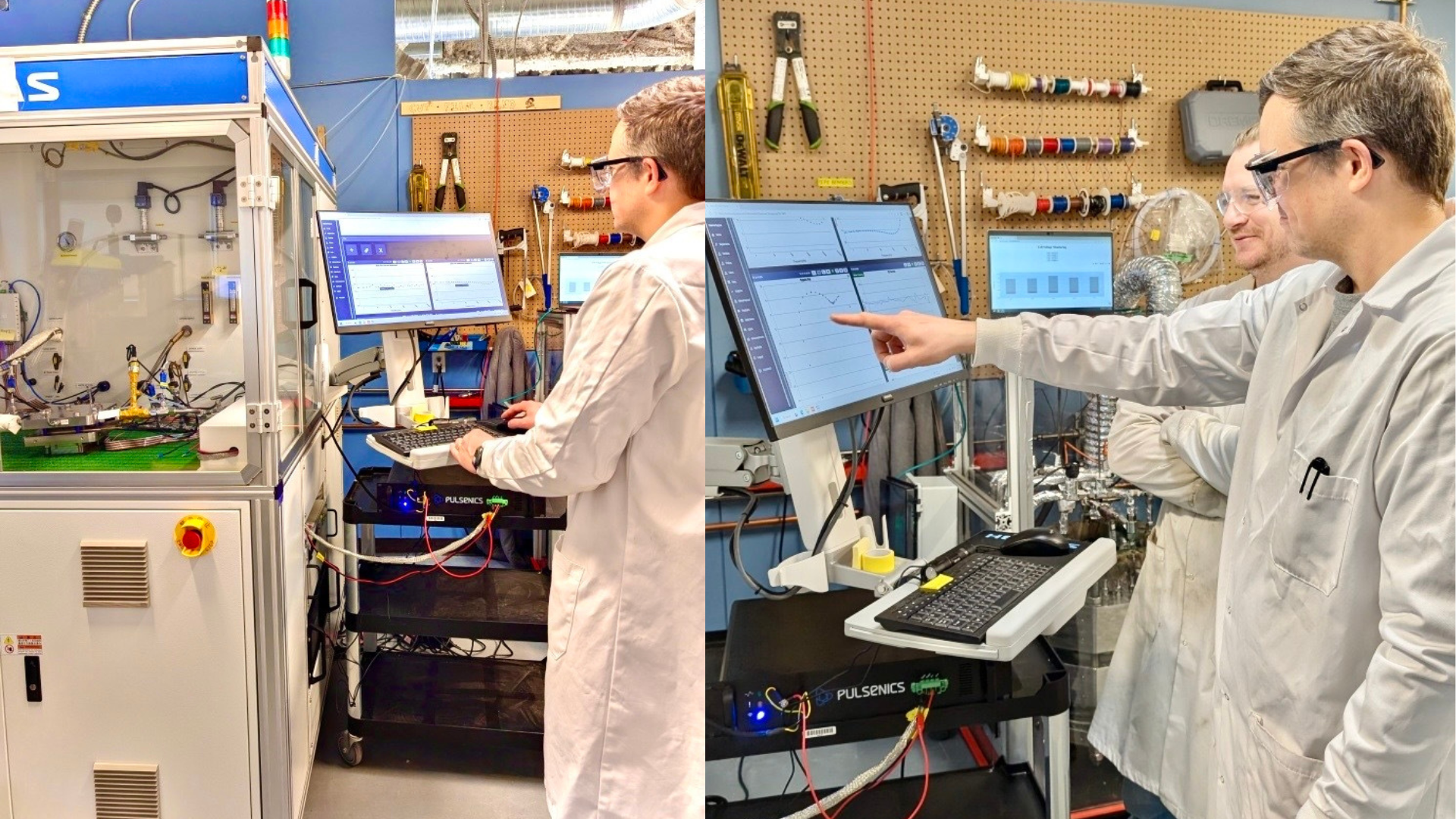
- Pulsenics Pulse Probes scanned Ayrton systems continuously during scale-up with electrochemical impedance spectroscopy (EIS), creating a comprehensive record of system performance.
- Pulsenics Lifetime Predictor took the guesswork out of optimizing operating conditions by simulating lifetime performance based on short-term experiments.
- Pulsenics research consultants collaborated with Ayrton's leadership and technical team every step of the way.
Results
- Ayrton developed the world’s first electrochemically driven e-LOHC™ system.
- Ayrton’s technology was able to achieve a 3,000x physical scale-up from lab cells to a commercial stack unit.
- Ayrton designed a significant commercial pilot ahead of their own internal timelines.
Want to bring your innovative hydrogen technology to market?

Want to know more?
As Ayrton wrote in a 2024 press release, clean hydrogen is expected to deliver up to 85 gigatons in cumulative CO2 emissions reductions by 2050. The market is expected to grow to $1.4 trillion annually by 2050, according to an outlook report by Deloitte. Two major bottlenecks stunting the growth of the clean hydrogen sector are the high costs of transport and lack of dedicated storage infrastructure.
Today, hydrogen fuel is shipped as either a compressed gas or cryogenic liquid. Both methods are logistically prohibitive and energy-intensive. Ayrton has invented a system called e-LOHC™ that binds hydrogen to a liquid organic hydrogen carrier (LOHC) with an electrochemical process. Ayrton’s technology allows hydrogen to be shipped through existing channels as easily as diesel and deployed virtually anywhere.
Ayrton, an early-stage startup, needed help scaling this groundbreaking tech. Pulsenics, who provides electrochemical diagnostic hardware and expert consulting, engaged with Ayrton to bring this groundbreaking technology to market.
One often-overlooked aspect of scaling a novel technology like e-LOHC™ is de-risking the path to market. Pulsenics prediction models, derived from operando EIS, gave Ayrton visibility into their technology without physically disassembling the unit or simply guessing at alternative formulations.
Pulsenics makes diagnostic equipment based on electrochemical impedance spectroscopy (EIS). Pulsenics hardware scans over 300 frequencies to get unique insights into the physical properties of electrochemical devices like Ayrton systems. That comprehensive data, plus the depth of experience of the Pulsenics team developing novel technologies, brought the two companies together on a mission to bring Ayrton’s invention to market faster.
“We needed a diagnostics partner who could stick with us for the long term,” said Ayrton CEO and Founder Natasha Kostenuk. “Our scientists wanted much more than the occasional scan. We wanted a deep body of customized knowledge that grew our capabilities over time, and Pulsenics delivered.”
Pulsenics and Ayrton collaborated for two years developing a database of EIS readouts on Ayrton system performance across different iterations of materials, sizes, and conditions. This unparalleled resource, built on comprehensive EIS data, was coupled with Pulsenics Lifetime Predictor to run predictive benchmarking campaigns. These campaigns shortened experiments from multiple months to just one week, radically accelerating Ayrton’s path to market and saving three years’ worth of cash.
“Hydrogen has so many valuable use cases, but that doesn’t mean anything if the fuel can’t travel to where it’s needed,” said Pulsenics Co-Founder and COO Mariam Awara. “Ayrton makes it possible to ship hydrogen as easily as diesel, and our team was honored to enable their first commercial pilot.”
The world’s first e-LOHC™ pilot will be up and running in 2026. Soon, green hydrogen will ship as seamlessly as diesel. The future of energy is on the way.