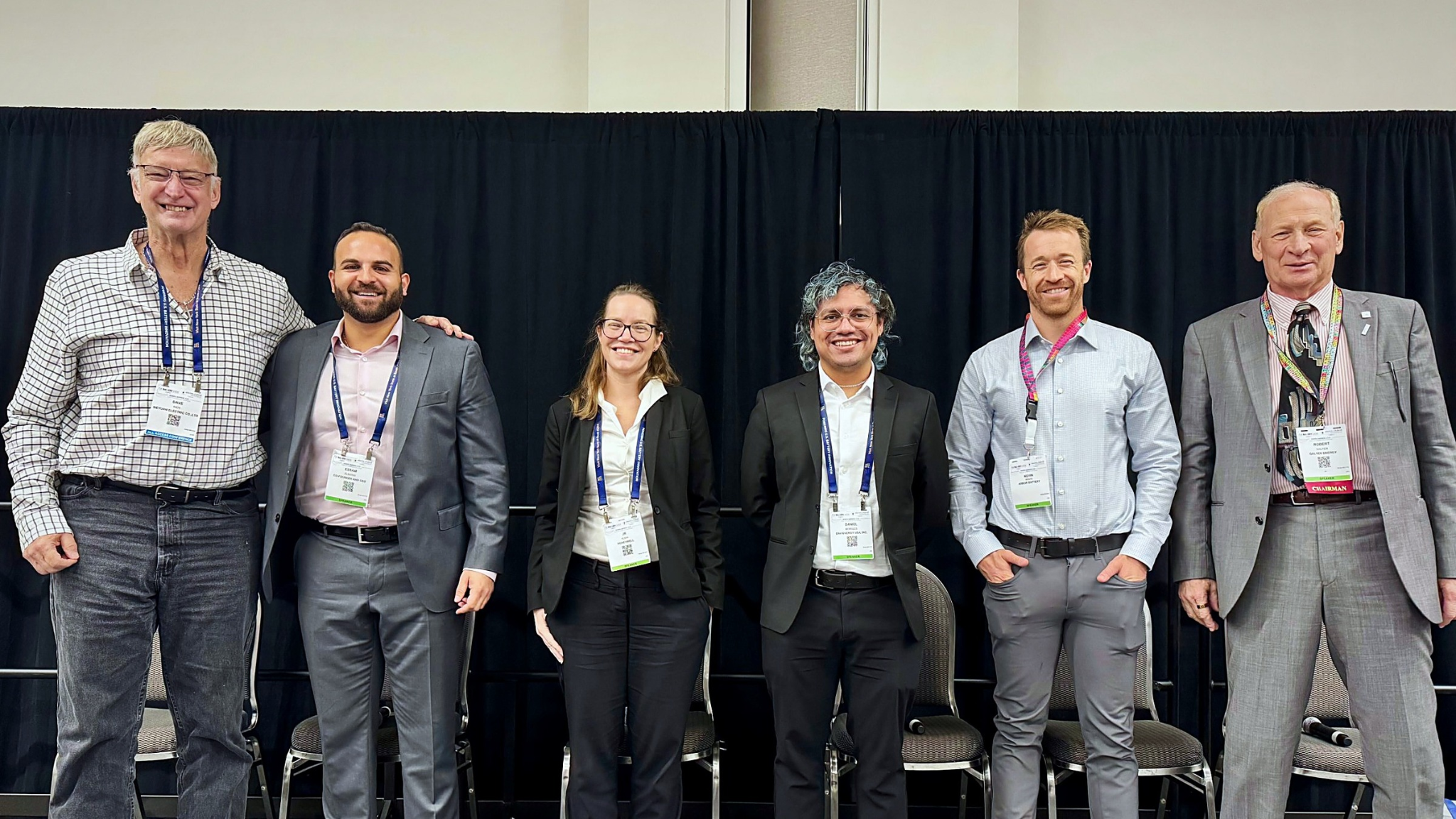
Pulsenics CEO Essam Elsahwi moderated a panel featuring Bob Galyen, JR Klein, Kevin Wood and Dr. Daniel Morales titled Minor Defects, Major Recalls this October at The Battery Show in Detroit. The panel explored how seemingly minor manufacturing issues can propagate through the production process and result in major financial, operational, and reputational challenges, along with solutions.
Please find below excerpts from the panel discussion and audience Q&A.
The scope of modern battery quality control
Daniel Morales, DNV: DNV primarily helps with underwriting of larger energy storage systems. There’s more of an understanding now, more than ever, that quality control is important. They no longer just trust the manufacturer and want to see third-party verification of good QC processes. Not only are there huge safety risks, there's reputational risks and a failure, there's huge commercial risks when you have an ESS failure because then you don't know if this is going to apply to your entire fleet.
JR Klein, Honeywell: The key is traceability. It starts with batch testing and continuous processing. The second half is the way you collect your data and the way you do your genealogy trees., You have to collect a lot of data for individual pieces so you can trace from the cell to the foil to the roll, to the marker within a roll that runs for 500 meters. You have to have as many quality control touchpoints as possible.
Bob Galyen, former CATL: When I left CATL, we had 3,600 control points on each cell. Today it’s 3,854. You can't lose a parts per million failure rate in building electric vehicles or large energy storage arrays because the quality has to be pristine. Every workstation on the line had a new registry, so as you start building the cell, you know exactly what lot of materials were made in the cathode, what was made in the anode, what foils were used, what winding machines they went on, what slitters went through, what counting process. It all accumulates into a large data set until that cell finally gets built and put into a shipping container.
The stakes of a quality control escape
Bob Galyen, former CATL: If the battery in a cell phone fails, you just replace it for the customer. But when you're talking about putting one bad cell into a pack that's 100 cells, you're paying for the entire battery pack for its takeout, replacement, shipping, transportation, both ways. So you typically pay somewhere between five and seven times as much for one battery pack that fails as you do for the original battery pack.
JR Klein, Honeywell: If you have to recall a car, the average cost is about $11,000 to bring it back to the dealership, replace the pack, send them on with a new pack. Whereas the cost for a single cell is maybe a couple dollars at most. So it's certainly much cheaper to catch it at the cell level before it gets to the pack, before it gets to the car and into the factory.
Daniel Morales, DNV: Yeah, and on the ESS side, you know, a single enclosure is on the order of a million dollars. And sometimes, you know, In a single failure that's expensive enough, but then that could propagate to additional enclosures. Or if you have a thermal event happening in one enclosure, the enclosures around it may not suffer a lot of damage, but now you start to have a lot of doubts as to whether or not those cells can be operated as well.
Kevin Wood, Arbor Battery: The earlier in the manufacturing process you can identify defects, the better off you are. So if you identify it at mixing, it's better to identify it there. If you identify it at coating, it's better to identify it there. As it goes, it starts to cost you more and more money in terms of material or time or resource allocation.
Contemporary techniques for identifying quality issues
JR Klein, Honeywell: EIS is always the magic sauce. Ultrasound has been turning out to be fantastically interesting and useful, and CT scans as well, because that really covers your whole range of electrical tests, physical tests, hard materials, soft materials. All of them together are quite necessary.
Daniel Morales, DNV: Redundancy is very important because a cell doesn’t live on its own. I've seen instances where going on manufacturing quality reviews, walking down the line, seeing a lot of redundant quality control points in integrating these batteries into a final product or a module. But they’re not checking if the incoming cells are up to snuff.
Bob Galyen, former CATL: Selecting the proper gauge for the process you’re trying to measure is very important. You may want to do your particle size distribution with a laser diffractometer, or you might want to do the thickness check with a laser, or you may want to check with a gamma radiation gauge. It just depends on what type of process you got. Many times a simple vision system works extremely well for minor defects. Sometimes you have to do online destructive technology like checking for wells, making sure your ultrasonic welding horn is working at the right energy levels so you don't have any foils that are not getting welded to the tabs.
JR Klein, Honeywell: I personally really love the ultrasound and EIS combination because you get both your electrical and then your physical defects. ****In addition to doing your process failure modes effects analysis, you can also do your design failure modes effects analysis. So let's say your battery is going through and the separator shrinks just a little bit in the vacuum oven and you didn't realize that. And now the adhesion between the separator and the electrode layers is not as good. And then your EIS is going to tell you, oh, there's more resistance between the layers. Is that a process failure or a design failure? Now you can go back and work in an iterative cycle.
How to use pack design to reduce the cost of replacements
Q: JR, is there a way to use design to reduce the cost of a pack replacement due to a bad cell?
JR Klein, Honeywell: Yes, that's a great question. So usually there's the pack, there's also the module level, and a lot of people will replace things at the module level. The module might only be eight or ten cells, and they are welded into place. And that's usually because if the eight or ten cells is still cheap enough compared to the time it takes to go out, pull that thing out and replace it. It's even, it's just cheap enough that you can just do it at the module level.
What you're specifically asking is if we could put in terminals that have screws, screw fittings on them, which yes, you absolutely can, however, When you do that, then you have to think about the surface interface of those two screw pieces and if it's just the right torque and if it's just the right surface area to get low resistance electrical current going through. And then over time, if that starts to rust or the metals expand differently over time as they age and heat, then do you still have the right contact?"
Are you getting the proper efficiency? It just creates more points of failure over time. So that's why people still opt for welding. It's fast, it's reliable, it's got low resistance. So that's really why they do screw things in at the module level, but they usually still replace at the module level. If you can figure out a better way to do it so we can do it that way, I will be happy to talk to you.
How to use EIS to enable second-life use cases
Q: I’m not a big fan of second-life batteries, because they can have latent defects due to swelling from its first-life use. How can you guarantee safety for second-life batteries?
JR Klein, Honeywell: The more quality control you have, the better you can guarantee that the battery will perform safely. Not every cell is swelling. Some are just aging. It’s important to be precise with your QC.
Q: How do you do that cost-effectively?
JR Klein, Honeywell: Personally, I would use EIS and ultrasound and CT scans to characterize the cell and then also start characterizing the defects. and then do some cycle testing over time to see how does that defect evolve to determine is this a very serious defect or is this a minor defect.
Essam Elsahwi, Pulsenics: We have a customer that operates probably the largest second-life distribution network in the US. They have a mandate to extract as many good cells from retired packs as they can and rebuild those packs again to redeploy them. And I think a lot of it goes back to the architecture of the pack or the module that you're working with because yes, the whole pack is say at 80% of course the end of the line, but a lot of times we see that not all the cells within a pack have aged the same way. And so, the quality controls are super important and being able to identify which of these cells should be or are homogeneous enough to be put in a pack. The customer came back and actually told us that the second-life packs, which they built, were performing better than new packs that they've received from their supplier. And it goes back to really two things. The capacity is one, so you're either cycling them or you're doing other advanced techniques to rapidly estimate capacity. But more importantly, you're also matching the SEI interface of each individual cell from something like EIS and then grouping those cells together in a pack.