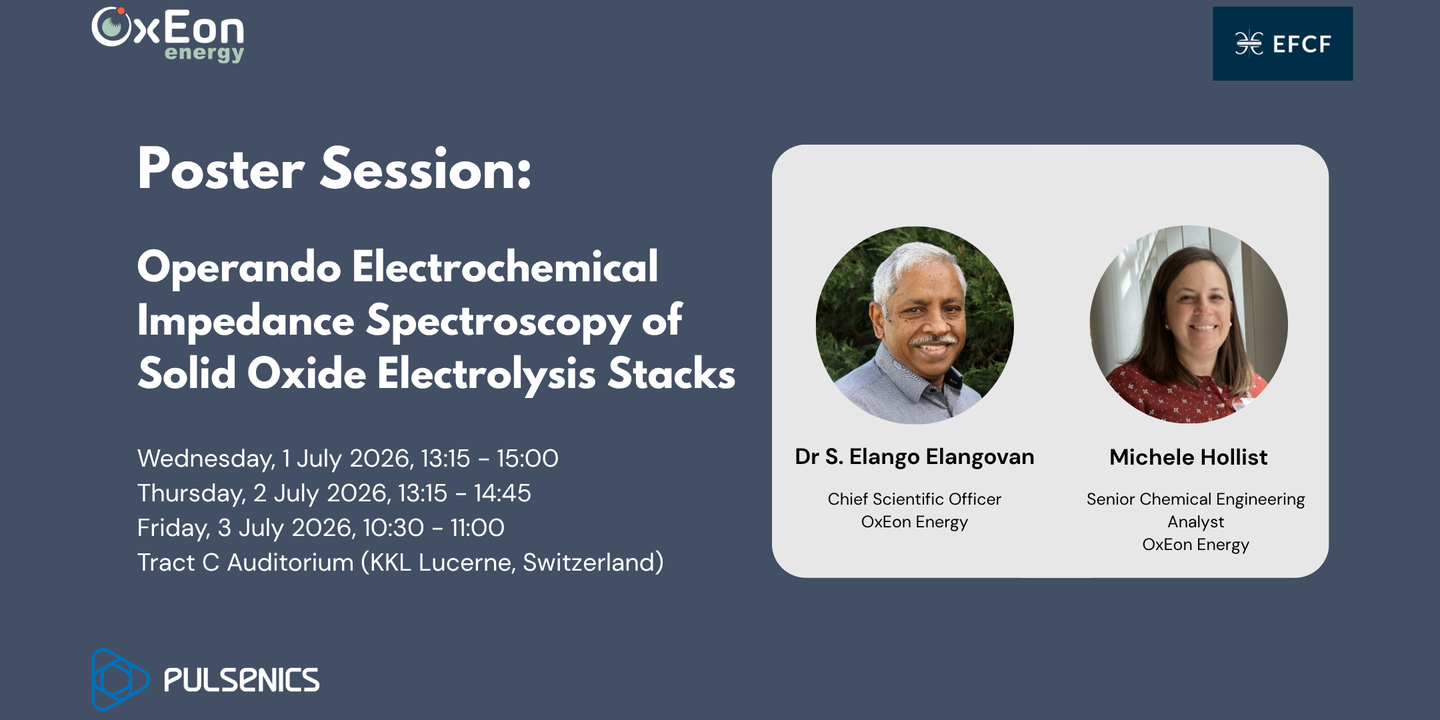
OxEon Energy, famous for producing oxygen on Mars, will present results on their collaboration with Pulsenics at the Electrolyser and Fuel Cell Forum (EFCF) 2026 in Lucerne, Switzerland. EFCF is an independent conference organized by scientists and technicians to share research.
OxEon, based in Utah, is a global leader in the development of Solid Oxide Electrolysis Cells (SOEC). EFCF will feature SOECs as a primary focus of the conference this year. OxEon will share results from SOEC test campaigns based on data from electrochemical impedance spectroscopy (EIS) monitoring equipment provided by Pulsenics.
Pulsenics, a leading provider of electrochemical diagnostics technology, supported OxEon with in-operando performance diagnostics equipment to support tests for different SOEC feedstocks. Pulsenics solutions are unique in their ability to provide real-time EIS insights for operating electrochemical stacks.
Dr. S. “Elango” Elangovan, CSO and Michele Hollist, Senior Chemical Engineering Analyst at OxEon Energy will present along with Pulsenics CEO and co-Founder Dr. Essam Elsahwi.
EFCF attendees are kindly invited to view the poster. An abstract of the presentation can be read below.
TITLE: Operando electrochemical impedance spectroscopy of solid oxide electrolysis stacks
Solid oxide electrolysis cells (SOECs) offer a versatile pathway for sustainable chemical production by converting mixtures of water and carbon dioxide (CO₂) into hydrogen, oxygen, or syngas through controlled adjustment of feed composition. While this operational flexibility broadens the range of end-use applications, CO₂-rich environments required for syngas generation can drive parasitic reactions and accelerate performance decay. Recent progress in cell architecture has increased achievable CO₂ utilization, yet comprehensive long-term studies remain essential to elucidate degradation mechanisms in CO₂-fed systems over realistic stack lifetimes.
This work investigates a novel SOEC stack architecture operated under three feed compositions: dry CO₂, steam, and mixed CO₂/steam. Long-duration durability tests (>500 hours) were conducted for each condition, supported by operando Electrochemical Impedance Spectroscopy (EIS) with Distribution of Relaxation Times (DRT) analysis for real-time performance assessment. Cell-resolved EIS enables detailed insight into how increasing CO₂ fractions and intrinsic cell-to-cell variability shape overall stack behaviour.
By integrating real-time, cell-level diagnostics with industrially relevant operating conditions, this study addresses a critical knowledge gap in SOEC degradation and stability across different operating modes. The findings provide directly actionable guidance for optimizing gas feed compositions and informing material and design improvements to extend stack lifetime and enhance SOEC reliability.