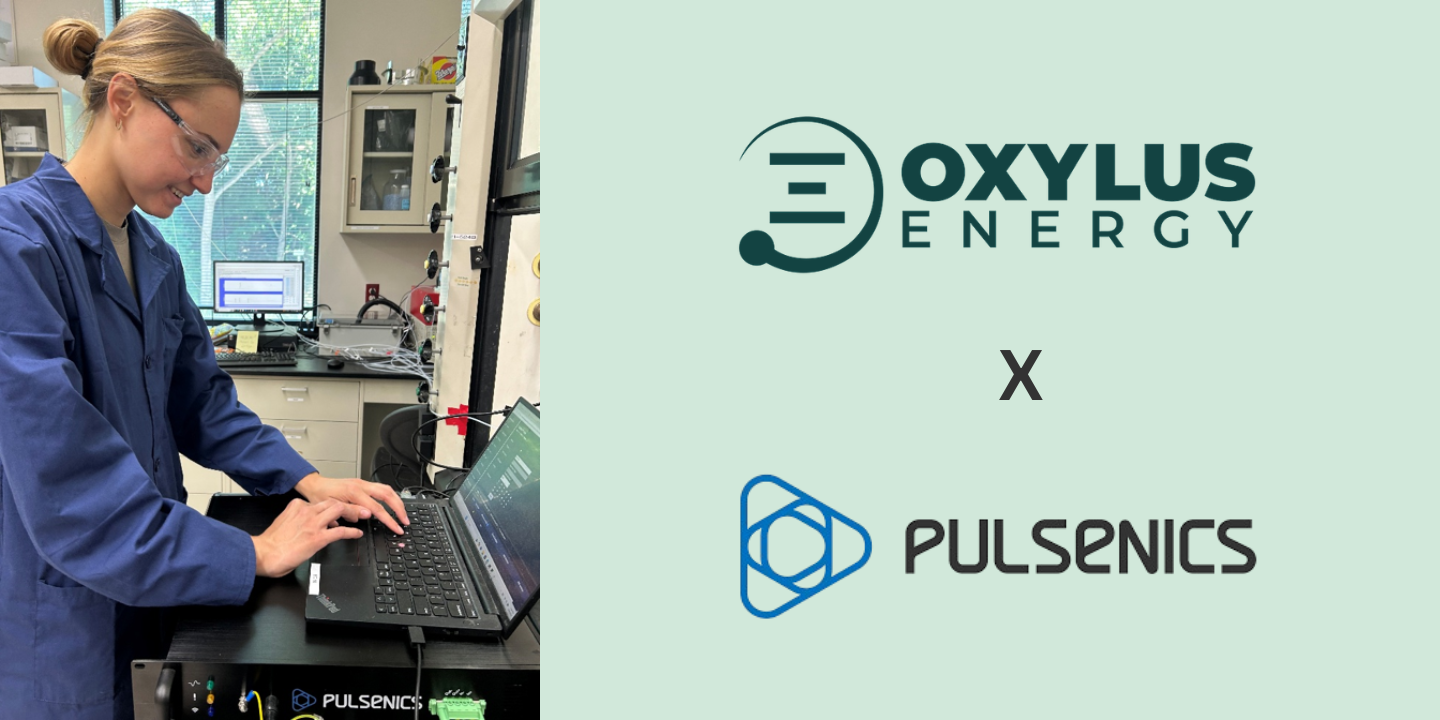
Oxylus Energy was founded in 2023 in New Haven, Connecticut to create green carbon-negative methanol at scale. Methanol, which was originally produced as wood alcohol, is typically made today from coal or natural gas in emissions-intensive processes. Methanol is an energy dense liquid that is used in countless applications including plastics, chemicals, and as a marine fuel.
Oxylus uses electrochemical technology to synthesize methanol using only CO₂, water, and renewable electricity. Their company mission is to achieve cost parity with fossil-based methanol, which will be achieved via breakthrough technology that improves the efficiency and reliability of the process.
Pulsenics and Oxylus began collaborating in the summer of 2025 when the Oxylus team realized they needed to de-convolute the data around their internal cell processes. Oxylus was using electrochemical impedance spectroscopy (EIS)devices but, because those legacy machines could only scan one frequency at a time within a limited range, it wasn’t easy for the research team to connect impedance measurements to specific cell processes that impact electrolyzer performance.
“It can take months to get impactful data out of EIS,” commented Kellie McCrea, Electrochemical Engineer at Oxylus. “With Pulsenics, we were able to get insightful data in just a couple of weeks. Because Pulsenics ships a purpose-built device and provides fantastic customer support, you minimize the time it takes to optimize the signal to your system."
Pulsenics EIS data feeds back to the design team as they iterate both cell and stack designs. The past 12 months have seen remarkable results. Durability, which is measured in hours of stack uptime, has increased from 500 hours to 5,000 (and counting). Cathodic surface area, which breaks carbon dioxide into carbon monoxide, has been scaled by a factor of 1,000. These advancements have moved Oxylus into a leading position in their nascent CO2 electrolysis industry, where they already hold patents on a catalyst that is 200 times cheaper than other CO2 conversion technologies.
As Oxylus develops their cell technology for pilot-scale stacks, it’s crucial that they have impedance data on a wide frequency spectrum. High-frequency data can help their research team optimize their catalyst layer resistance. Low-frequency data allows them to improve CO2 gas transport within the system. Traditional EIS devices, which lack Pulsenics’ high-power architecture, cannot reach either of these frequency bands.
Kellie commented, “When we hit cost parity between green and fossil methanol, it’s going to unlock access to a trillion-dollar market. Achieving cost parity comes down to specs like run time. Our pilot stack is operating now. Our pilot plant is coming in the next two years. We’ll get there, and the support we get from Pulsenics will be a part of that story.”