
For decades, potentiostats have been the standard in electrochemical testing. But as electrochemical systems scale; think multi-cell electrolyzer stacks, battery gigafactories, and 24/7 operations; the limitations of tools built for the lab are not necessarily optimal for factories at scale. Potentiostats serve a specific niche in exploratory research situations that are not suitable for industrial development and high throughput QA/QC on the production line for high-power architecture. Enter the Pulse Probe: purpose-built for industrial applications, delivering in-line, real-time Electrochemical Impedance Spectroscopy (EIS) that fits industrial workflows and delivers the insights that matter.
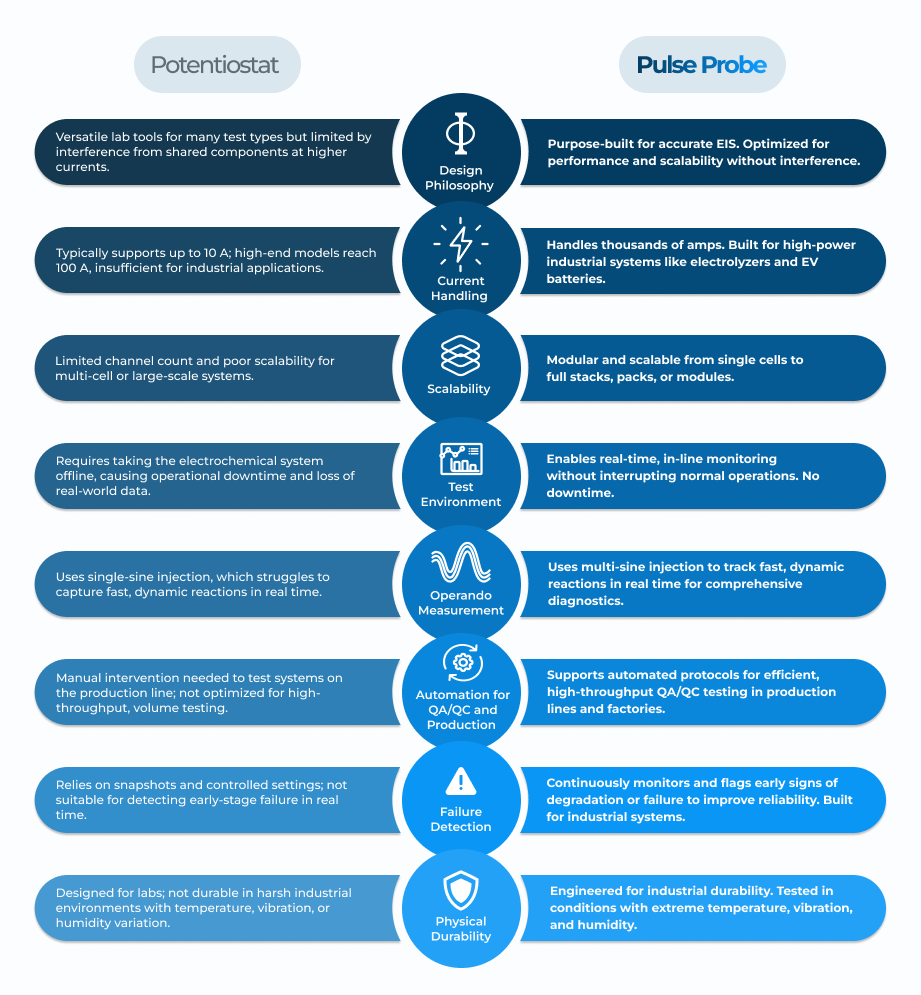
The Pulse Probe ≠ Potentiostats. Here’s Why:
Different design philosophies
Potentiostats are versatile lab tools designed to perform a wide range of electrochemical tests. However, this versatility comes at the cost of scalability especially at higher currents.
Pulsenics' Pulse Probes are purpose-built for one thing: delivering accurate EIS measurements. By focusing on this single function, every component is optimized for performance and scalability, no compromises, no interference, just diagnostics built for industrial environments.
Current Handling
Traditional potentiostats are built for low-current settings. The Pulse Probe is designed for industrial scale diagnostics. Industrial electrolyzers and EV batteries operate at currents reaching thousands of amps, and getting reliable diagnostics at that scale is a real gap in the market. Standard laboratory potentiostats are limited to low currents, far short of what these systems demand.
Pulsenics' in-line EIS systems are built for industrial electrochemical environments, designed to operate at currents reaching thousands of amps. Our hardware brings electrochemical diagnostics to high-power systems without compromise, so you can scale without limits.
Scalability
Potentiostats don’t scale with size. The Pulse Probe does. Traditional potentiostats have a limited number of channels which struggle to keep up with large systems or multi-cell setups. At Pulsenics, we take a different approach. Our systems and built around modularity that allows us to scale seamlessly from single cells to full stacks and packs, making them ideal for industrial workflows and high throughput testing.
Operando Measurement
The Pulse Probe eliminates downtime, offering uninterrupted, in-line electrochemical monitoring. Traditional potentiostats need the device under test to be taken offline, slowing operations and missing the real-world picture. Pulsenics’ hardware flips the script with in-situ diagnostics that deliver real-time insights while your electrochemical system runs the way you need it to. In the lab, or on the production line.
Speed
You can't tell much from a snapshot. Traditional potentiostats typically employ single-sine injection, which cannot capture fast, dynamic reactions in real time without also seeing measurement drift. The Pulse Probe, on the other hand, leverages multi-sine injection to capture a complete picture of active electrochemical processes, and monitor how they evolve in real-time, unlocking detailed diagnostics and better visibility into electrochemical behavior.
Automation & QA/QC
Potentiostats typically require manual setup and operator intervention for each test, an approach suited to research settings but not to production environments, where it limits throughput exactly where automated QC matters most. At Pulsenics, we take a streamlined approach. The Pulse Probe sits in-line, enabling seamless integration with QA pipelines and high-throughput testing, making it a perfect fit for QA/QC in fast-paced production environments.
Failure Detection
Early warnings enable proactive response. Traditional potentiostats rely on controlled test environments and isolated snapshots, making them poorly suited to detect early-stage failures in real time. Continuous monitoring with our in-line EIS hardware enables proactive identification and flagging of emerging degradation patterns and failure mechanisms, leading to enhanced system reliability and safety.
Physical Durability
Complex operations need technology that can keep up. Designed for temperature-controlled labs, traditional potentiostats lack durability in industrial settings. The Pulse Probe is engineered for rugged environments. Our hardware is built with robust enclosures and tested for operation in temperature, vibration, and humidity extremes typical of field or factory conditions.
Potentiostats remain well suited to their original purpose: exploratory research in controlled laboratory conditions. Industrial electrochemical systems, however, including multi-cell stacks, high-volume production lines, and continuous operations, require a different set of capabilities. The Pulse Probe was developed to meet those requirements directly, addressing the gaps outlined above.
The Pulse Probe is not an incremental improvement on the potentiostat. It is a purpose-built instrument for industrial-scale electrochemical diagnostics.
Want to learn more about our core technology? Check it out below:

Want to know more about Pulsenics products? Book a call with us below: