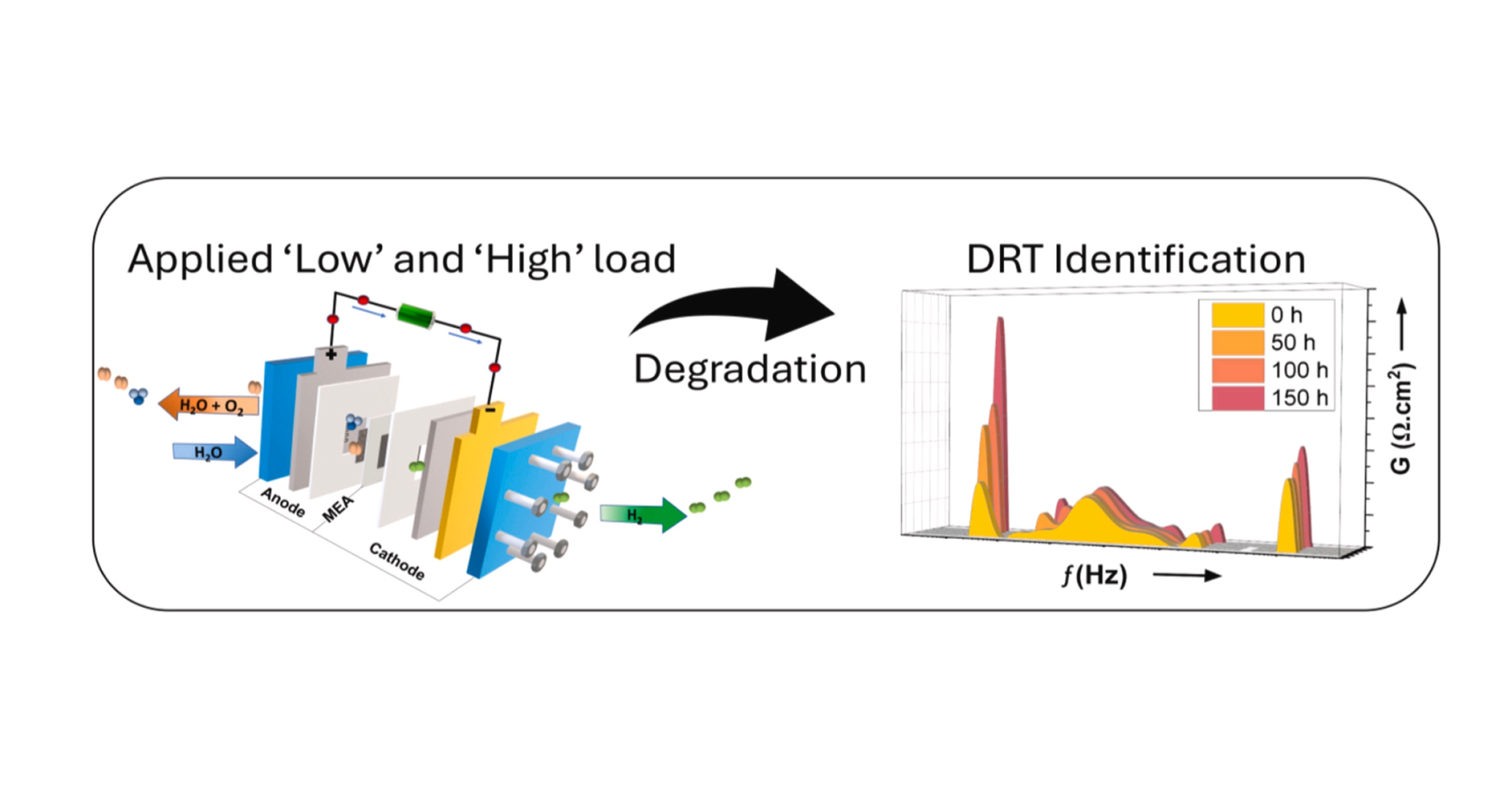
Green hydrogen can solve many of the world’s energy problems if we can solve the problem of cost. Today, the cheapest power in the world comes from intermittent solar delivered during peak hours. Hydrogen producers want to optimize their stacks for these intermittent inputs but constant on/off cycling degrades assets, making stack durability a critical bottleneck.

PTLs suffer most under intermittent conditions
One of the electrolyzer components that suffers the most from intermittent power supply is the porous transport layer (PTL). PTLs, made of mesh-like material and part of the anode side of the cell, are the focus of much of today’s industrial R&D. Researchers worldwide are testing different materials to optimize for two competing pressures: performance under real operating conditions and supply chain availability.
This makes PTL degradation expensive to misdiagnose. Post-mortem analysis tells you a cell failed. It rarely tells you why, or when the decline began.
Over 25 days, NRC and UQTR researchers ran a test campaign using Pulsenics diagnostic equipment to apply electrochemical impedance spectroscopy to PTL diagnostics under intermittent accelerated stress. We're honored to publish the results in the International Journal of Hydrogen Energy, in "Operando DRT insights into degradation of porous transport layers under intermittent accelerated stress tests in PEM water electrolyzers."
The results show that operando EIS does more than monitor PTL degradation. It isolates the source of the failure, and it detects precursors, the early warning signs that appear well before performance drops.
DRT insights can predict failure modes for PTLs
Researchers from UQTR and NRC built PEM electrolyzer cells and ran them through repeated cycles of 6 hours on, 18 hours off, for approximately 25 days straight, at both a gentle load (low-stress condition) and a hard load (high-stress condition). The test campaign mimiced real-world renewable-powered operation, based on our team’s knowledge serving green hydrogen producers in the field.
We tested three PTL materials:
- C-MPL: carbon paper with a microporous layer
- u-Ti: plain, uncoated titanium felt
- Pt-Ti: titanium felt coated in platinum
Throughout the campaign, NRC, UQTR, and Pulsenics monitored every cell with operando EIS and converted the spectra into DRT signatures. Because DRT separates overlapping electrochemical processes by their characteristic timescales, the team could watch distinct degradation mechanisms develop side by side, and predict the failure mode for each material before it arrived.
Every cell eventually reached failure, by design. The team then disassembled each one and examined it with electron microscopy, elemental mapping, and contact resistance testing, matching the physical evidence of failure back to the EIS signatures recorded while the cell was still running.
This methodology enabled the development of a PTL failure catalogue, isolating for the mechanisms associated with PTL degradation in response to accelerated stress testing using operando DRT.
Read the paper to get the details
Pulsenics has been supporting researchers in industry, academia and government since our founding seven years ago. We believe in the transformative possibilities of green hydrogen and recognize that the biggest levers to achieving global scale are uptime and quality control.
With this paper, written with partners and reviewed by the International Journal of Hydrogen Energy, we have demonstrated that Pulsenics impedance spectroscopy technology can provide green hydrogen innovators the data they need to improve stack uptime. Read the full piece to learn the specific failure modes for different materials, see actual data, and consider how your organization can use EIS to iterate electrolyzers faster.
Abstract
The porous transport layer (PTL) is crucial in proton exchange membrane water electrolyzers (PEMWEs), facilitating mass transport and maintaining strong PTL-catalyst layer (CL) contact. However, PTL degradation limits operational lifetime and cost-effectiveness. Previous studies often rely on ex-situ methods, lacking rapid diagnostics for degradation pathways. This study employs operando Distribution of Relaxation Times (DRT) to diagnose PTL-induced degradation by tracking estimated resistances associated with characteristic relaxation times. Three PTLs—carbon paper with microporous layer (C-MPL), uncoated Ti felt (u-Ti), and Pt-coated Ti felt (Pt–Ti)—were investigated under intermittent accelerated stress tests (ASTs) involving low- and high-load cycling (1-0 and 3-0 A/cm2). SEM-EDS and interfacial contact resistance (ICR) further confirmed microstructural damage and contact losses. C-MPL showed a 15-fold rise in mass transport resistance under high-load AST, while oxidized u-Ti exhibited increased contact resistance. Operando DRT serves as a rapid diagnostic tool for PTL selection and quantifying degradation in AST protocols.
Highlights
- Operando DRT enables in situ isolation of PTL-induced degradation from other components.
- Intermittent AST with shutdown periods accelerates PTL degradation pathways.
- Degradation modes of different PTLs are identified via operando DRT peaks.
- Uncoated Ti degradation driven by passivation increases contact resistance peak.