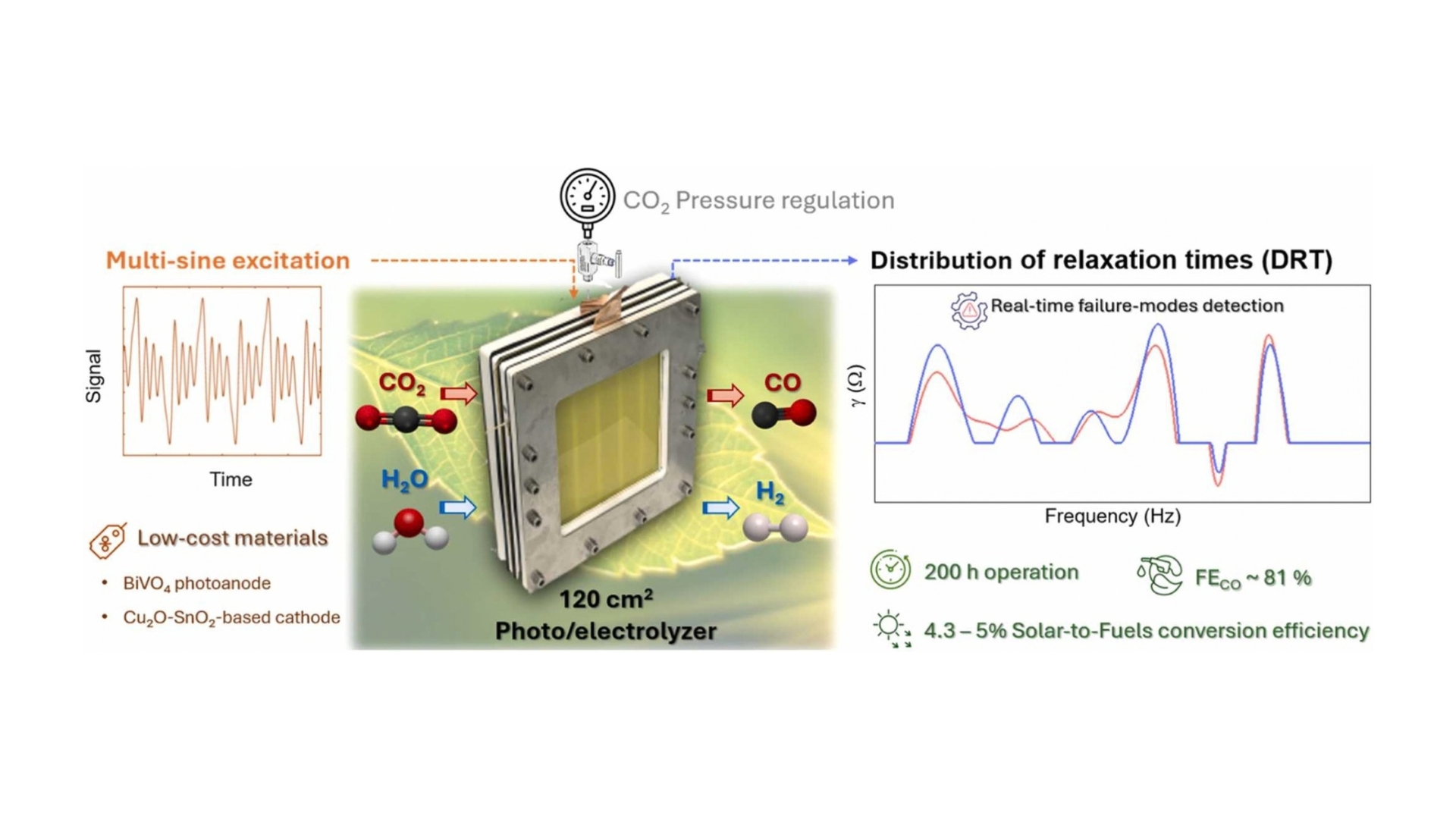
CO₂ electrolysis is a promising pathway for industrial decarbonization, but scaling from laboratory cells to prototype systems introduces new operational challenges. As cell area grows, so does the complexity of maintaining stable, durable performance. Understanding what is happening inside the system in real time becomes critical.

Gas analysis tells you something went wrong. EIS tells you what, and when.
In a CO₂ electrolyzer, performance degradation can stem from several sources: electrode flooding, catalyst dissolution, or pressure instability. Gas product analysis captures the end result. It does not isolate the cause, and it rarely catches the warning signs early enough to intervene.
As the paper states, conventional gas-product analysis provides only delayed and indirect information. Operando EIS addresses this directly by continuously monitoring the electrolyzer’s internal electrochemical response in real time, capturing changes in system behavior before they manifest as measurable performance loss.
200 hours of continuous monitoring on a 120 cm² prototype
A core objective of the EU-funded SunCoChem project is scaling CO₂ electrolysis from small lab cells to industrial-scale systems. This study represents a key step in that journey, moving from a 10 cm² commercial flow cell to a custom-built 120 cm² prototype. Researchers at Politecnico di Torino designed and validated this prototype for CO-rich syngas production, with Pulsenics providing EIS hardware and analytical support throughout.
The prototype was connected to Pulsenics' Pulse Probe for continuous operando EIS monitoring over more than 200 hours of operation. The test campaign deliberately introduced stress conditions including gas chamber overpressure, GDE flooding induced by pressure reduction, and light-assisted operation simulating solar-driven conditions. All EIS measurements were validated through the Kramers-Kronig test in the Pulse Hub analytics suite, with a root-mean-square error below 5% across all conditions.
Two failure modes, identified in real time
The results, published in the Journal of CO₂ Utilization, demonstrate that operando EIS coupled with Distribution of Relaxation Times (DRT) analysis can distinguish and identify distinct failure modes as they develop.
GDE flooding produced a clear impedance signature: an increase in mass transport resistance at low frequencies and a rise in charge-transfer resistance, consistent with electrolyte intrusion into the gas diffusion electrode. Overpressure, by contrast, affected only the ohmic resistance, leaving reaction kinetics essentially unchanged. The two conditions produced markedly different EIS responses, demonstrating that operando monitoring can not only detect degradation but isolate its source.
The Pulse Probe also detected early-stage photoanode degradation through a negative DRT feature associated with vanadium leaching from the BiVO₄ photoanode. This is a progressive failure mode that would be invisible to gas analysis until the anode had already lost significant activity.
A non-invasive diagnostic framework for CO₂ electrolysis
Pulsenics has been supporting researchers in industry, academia, and government since our founding. This collaboration with Politecnico di Torino and the broader SunCoChem consortium reflects our commitment to working closely with research partners to advance the state of electrochemical diagnostics in real operating environments.
This publication demonstrates that operando EIS provides a non-invasive diagnostic framework that complements traditional gas product analysis, delivering real-time insight into failure modes that would otherwise remain hidden until performance has already declined. The approach is directly applicable to the development of more durable CO₂ electrolyzer systems at prototype and industrial scale.
Read the full paper for the complete dataset, DRT spectra, and failure mode analysis.
Abstract
Solar-driven CO₂ reduction technologies face unique challenges when transitioning from laboratory to prototype scale. Within the European Union-funded SunCoChem project, a photoelectrochemical reactor was designed and validated for CO₂ conversion to a CO-rich syngas stream, scalable to 2400 cm², for subsequent upgrading in a hydroformylation unit. Here we couple operando electrochemical impedance spectroscopy with distribution of relaxation times analysis on a 120 cm² device, and combine it with targeted stress testing, to resolve and monitor failure modes in real time. The prototype sustained CO-dominant operation for over 200 hours at 6.1 mA cm⁻², with average Faradaic efficiencies of approximately 81% to CO and 10% to H₂. DRT resolved distinct impedance signatures associated with gas-chamber overpressure, GDE flooding and photoanode degradation, providing a non-invasive diagnostic framework. We discuss the current technological bottlenecks and outline strategies for further optimization and scale-up.