
Who this is for: Electrochemical scientists across multiple industries.
PROBLEM: Performance loss in electrochemical systems can be extremely difficult to diagnose. Without knowing why system performance is failing, product design and technoeconomic design can be largely guesswork.
SOLUTION: The Pulsenics Pulse Probe
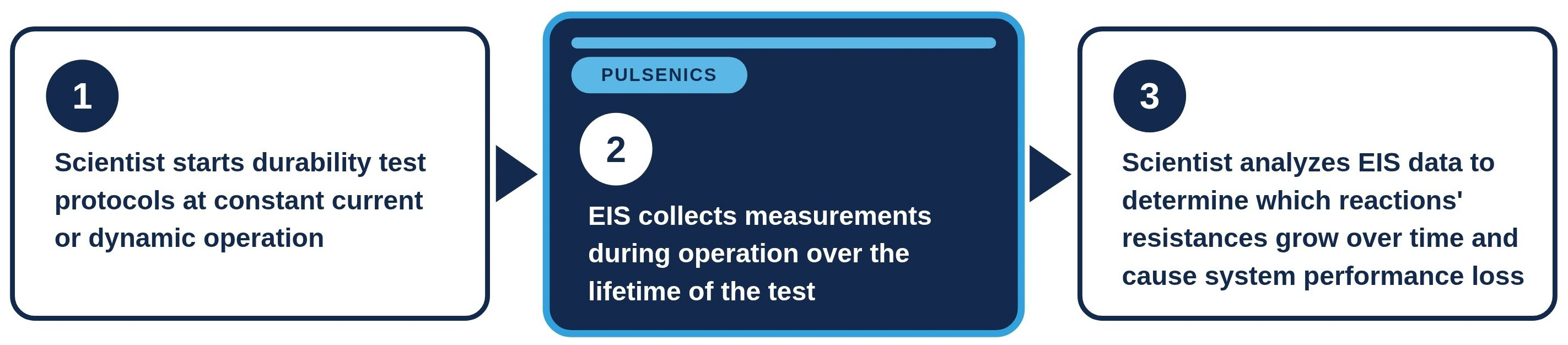
About pinpointing performance loss
Performance loss in electrochemical systems needs to be traced to the root cause. The best way to find the root cause is with degradation benchmarking based on electrochemical impedance spectroscopy (EIS).
Degradation benchmarking involves systematically tracking how an electrochemical system’s performance declines over time. Good benchmarking with EIS enables engineers, researchers, and scientists to establish reliable baselines and support their guarantees to customers.
Today, degradation benchmarking with traditional EIS typically requires manual, point-in-time measurements taken at scheduled intervals. Engineers disconnect assets, run single-frequency or narrowband sweeps, and piece together degradation trends from sparse, infrequent snapshots. The result is a fragmented picture of performance decline, with gaps between measurements that can mask the onset of critical failure modes.
The Pulsenics Pulse Probe series monitors electrochemical assets, such as batteries or hydrogen stacks, continuously and non-invasively. With its real-time monitoring capabilities, the Pulse Probe scans across hundreds of frequencies to produce ongoing streams of impedance data. These insights allow electrochemical scientists to precisely identify quality problems long before they manifest as system failures.
One the source of performance loss has been identified, product teams can embark on other important workstreams, including:
- Cell Design: Evaluate how different materials, membranes, and cell architectures degrade over time, enabling data-driven design choices that improve durability and long-term performance.
- Optimizing Operating Parameters: Identify the operating conditions, such as current density, temperature, and power cycling patterns, that minimize stress and slow degradation rates.
- Scale-Up: Validate that performance and degradation characteristics observed at the single-cell level translate reliably to full stacks and industrial-scale systems, reducing risk during commercialization.
- Lifetime Prediction: Leverage continuous degradation tracking and machine learning models to forecast how long a system will remain within acceptable performance thresholds.
The Pulse Probe Difference
POWER
The Pulsenics Pulse Probe series is a step-change innovation in the history of EIS diagnostics. It’s the world’s most powerful EIS.
- High-voltage, high-current capability for industrial scale diagnostics
- EIS under load for 5MW+ assets
- Test as low as 0.01 Hz with total confidence
- Scale your testing protocols to industrial volume
CONVENIENCE
Are you waiting for teardown to run EIS on your assets? Stop waiting. Pulse Probes can install wherever you’re working, today, and run operando.
- Real-time monitoring for H2 production, battery formation, and end-of-line testing
- Non-invasive install keeps your electrochemical assets intact
- Easy-to-use plug-and-play design for immediate deployment.
SCALABILITY
Pulse Probes can monitor an unprecedented number of assets through our modular, scalable, high-power architecture.
- Monitor hundreds of cells simultaneously
- See your data in real-time and leverage our proprietary ML models to predict asset performance
- Advanced analytics and automated analysis speed your workflows
INSIGHT
Pulse Probes gather data, and the Pulse Hub software layer transforms data into insight.
- Industry-leading machine learning and predictive capabilities
- Research database of 20,000 hours of impedance testing data (and growing) developed with our public-sector research partners
- Automated parameter extraction of resistances and capacitances
Traditional EIS can’t match the Pulse Probe for power or throughput
Your benchmarking team works hard to produce great results, but legacy technologies prevent them from getting to the next level. Why not enable your team to do that work faster, cheaper, and more thoroughly? Contact a Pulsenics consultant today.
